£40k After Tax UK: Monthly Take-Home Pay in 2026/27
Find Out How Much You Keep From a £40,000 Annual Salary After Income Tax and National Insurance

A £40,000 salary sounds pretty good. But how much money actually reaches your bank account each month? That is the question many UK workers ask before accepting a new job, changing careers, or planning their household budget.
If you earn £40,000 per year in the UK, your take-home pay depends on Income Tax, National Insurance, your tax code, and any extra deductions from your wages.
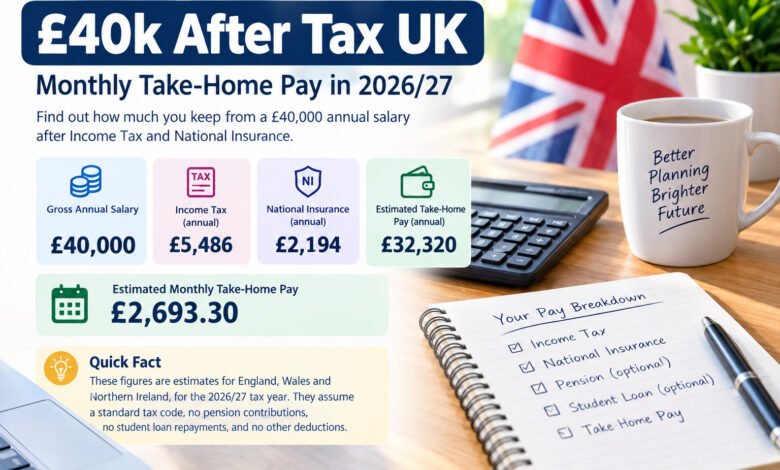
For the 2026/27 tax year, a standard employee in England, Wales, or Northern Ireland can expect approximately £32,320 per year after Income Tax and National Insurance. That works out to around £2,693 per month.
Here is how the calculation works.
Quick Fact: £40k After Tax UK
| Salary Detail | Amount |
|---|---|
| Annual gross salary | £40,000 |
| Monthly gross salary | £3,333.33 |
| Annual Income Tax | £5,486 |
| Annual National Insurance | £2,194 |
| Estimated annual take-home pay | £32,320 |
| Estimated monthly take-home pay | £2,693.30 |
| Estimated weekly take-home pay | £621.53 |
| Estimated hourly take-home pay | £16.57 |
Note: These are estimated figures for England, Wales, and Northern Ireland for 2026/27. They assume a standard tax code, no pension contributions, no student loan repayments, and no other deductions. Actual payslips can differ slightly.
How Much Is £40k After Tax in the UK?
A £40,000 annual salary gives you a gross monthly income of £3,333.33 before deductions.
After Income Tax and National Insurance, the estimated monthly amount is £2,693.30.
That means you keep roughly 80.8% of your gross salary. The remaining amount goes towards tax and National Insurance.
Here is the simple breakdown:
- Gross annual salary: £40,000
- Income Tax: £5,486
- National Insurance: £2,194
- Total deductions: £7,680
- Net annual salary: £32,320
Honestly, the monthly figure matters most for many workers. Rent, food, transport, bills, and savings all come from that money.
£40,000 Salary After Tax Per Month
A monthly salary calculation makes budgeting much easier. Most employees receive their wages monthly, so knowing the net amount helps with everyday planning.
| Monthly Salary Breakdown | Amount |
|---|---|
| Gross monthly salary | £3,333.33 |
| Income Tax | £457.17 |
| National Insurance | £182.87 |
| Estimated net salary | £2,693.30 |
You would receive approximately £2,693 each month.
However, this is an estimate. Your employer calculates deductions through PAYE payroll. The amount may change if your tax code or employment details change.
£40k After Tax UK: Annual, Monthly, Weekly and Daily Pay
People often search for £40k after tax UK because they want to understand their income across different pay periods.
Here is a useful comparison.
| Pay Period | Gross Pay | Estimated Take-Home Pay |
|---|---|---|
| Yearly | £40,000 | £32,320 |
| Monthly | £3,333.33 | £2,693.30 |
| Weekly | £769.23 | £621.53 |
| Every four weeks | £3,076.92 | £2,486.12 |
| Daily (5-day working week) | £153.85 | £124.31 |
| Hourly (37.5 hours per week) | £20.51 | £16.57 |
Daily and hourly figures are estimates based on the stated working pattern. They are not necessarily the rate shown on every employment contract.
How Income Tax Works on a £40,000 Salary
The UK Income Tax system uses different tax bands. Your income is taxed according to the amount that falls within each band.
For the 2026/27 tax year, the standard Personal Allowance is £12,570.
This means you can earn £12,570 before paying standard Income Tax, provided you qualify for the full allowance.
For a £40,000 salary, the calculation is:
- Annual salary: £40,000
- Personal Allowance: £12,570
- Taxable income: £27,430
- Basic Income Tax rate: 20%
- Estimated Income Tax: £5,486
The calculation is simple:
£27,430 × 20% = £5,486
So, the estimated annual Income Tax bill is £5,486.
UK Income Tax Bands for 2026/27
For England, Wales, and Northern Ireland, the standard bands are:
| Tax Band | Taxable Income | Rate |
|---|---|---|
| Personal Allowance | Up to £12,570 | 0% |
| Basic Rate | £12,571 to £50,270 | 20% |
| Higher Rate | £50,271 to £125,140 | 40% |
| Additional Rate | Above £125,140 | 45% |
A £40,000 salary falls within the basic-rate band under these standard rules.
Scotland has different Income Tax bands. Scottish taxpayers should check their own calculation rather than relying on the figures above.
National Insurance on £40k Salary
National Insurance is another deduction from your wages.
Employees usually pay Class 1 National Insurance through their employer’s PAYE payroll. The amount depends on earnings and the applicable thresholds.
For most employees in 2026/27, the main employee National Insurance rate is 8% on earnings between the Primary Threshold and Upper Earnings Limit. Earnings above the Upper Earnings Limit are generally charged at 2%.
For a £40,000 salary, the estimated annual National Insurance deduction is around £2,194.
The monthly amount is approximately £183.
This deduction is separate from Income Tax. Both affect your take-home pay.
Is £40,000 a Good Salary in the UK?
A £40,000 salary can provide a reasonable income for many workers. But whether it feels comfortable depends heavily on where you live and your personal expenses.
Think about it.
Someone living in a lower-cost area may have more money left each month. A person renting in an expensive city could face much higher housing costs.
Your lifestyle matters, too.
A single worker with limited expenses may find £2,693 per month manageable. A household with children, rent, transport costs, and debt repayments may need a tighter budget.
There is no single answer for everyone.
Can You Live on £40k After Tax?
Yes, many people can live on a £40,000 gross salary. The actual comfort level depends on your rent or mortgage, household size, location, and spending habits.
A simple monthly budget could include:
- Housing costs
- Council Tax
- Gas and electricity
- Food and groceries
- Travel expenses
- Phone and internet
- Savings
- Personal spending
The best way to judge the salary is to compare your expected expenses against your actual take-home pay.
£40k After Tax in Scotland
Scotland uses its own Income Tax bands for employment income.
This means a person earning £40,000 in Scotland may have a different Income Tax deduction compared with someone earning the same amount in England, Wales, or Northern Ireland.
National Insurance is generally based on UK-wide employee rules.
If you live in Scotland, check the Scottish Income Tax rates for the relevant tax year. Your Scottish taxpayer status is determined by HMRC rules, not simply by your workplace address.
For an accurate result, use a salary calculator that includes Scottish tax bands.
What Happens to £40k After Pension Contributions?
Pension contributions can reduce your monthly take-home pay.
The exact effect depends on your pension arrangement, contribution percentage, and how your employer operates the scheme.
For example, a workplace pension may deduct contributions directly from your salary. Some schemes use salary sacrifice, while others use different contribution methods.
This means two employees earning £40,000 could receive different monthly amounts.
Your pension contribution is not necessarily lost money. It is generally intended to build retirement savings, subject to the rules of your scheme.
Check your payslip to see how the contribution is calculated.
£40k Salary With Student Loan Repayments
Student loan repayments can also affect take-home pay.
The repayment amount depends on your loan plan and the applicable income threshold. Different plans have different repayment rules.
If you have a student loan, your employer may deduct repayments through payroll.
That means the £2,693 estimated monthly take-home amount could be lower.
To get a more accurate figure, check your student loan plan and use the official UK salary calculator.
How to Calculate Your £40k Take-Home Pay
You can estimate your take-home salary using a simple process.
First, check your annual gross salary. In this example, it is £40,000.
Next, subtract the standard Personal Allowance of £12,570 to calculate taxable income.
Then calculate Income Tax using the relevant tax band. For the standard calculation, the taxable amount is charged at 20%.
After that, estimate your National Insurance contributions using the applicable thresholds.
Finally, subtract both deductions from your gross salary.
Remember that pension contributions, student loans, tax code changes, and other payroll deductions can affect the final result.
For the most accurate estimate, use the official HMRC Income Tax calculator.
Frequently Asked Questions (FAQs)
1. How much is £40k after tax UK per month?
A £40,000 annual salary gives an estimated monthly take-home pay of £2,693.30 in England, Wales, and Northern Ireland for 2026/27, before pension and student loan deductions.
2. How much is £40,000 after tax per year?
The estimated annual take-home salary is £32,320 after standard Income Tax and National Insurance deductions.
3. How much tax do I pay on a £40k salary?
The estimated Income Tax is £5,486 per year under the standard 2026/27 calculation for England, Wales, and Northern Ireland.
4. How much National Insurance do I pay on £40k?
The estimated annual employee National Insurance contribution is around £2,194, subject to payroll calculations and applicable thresholds.
5. Is £40k a good salary in the UK?
It can be a good salary for many people. However, your location, housing costs, family responsibilities, and lifestyle affect how comfortable it feels.
6. Is £40k after tax the same in Scotland?
No. Scotland has different Income Tax bands, so the take-home amount can differ from England, Wales, and Northern Ireland.
7. How much is £40k after tax per week?
The estimated weekly take-home pay is approximately £621.53, based on the standard annual calculation.
8. Does a pension reduce my £40k take-home pay?
Yes. Workplace pension contributions can reduce the amount you receive each month. The exact deduction depends on your pension scheme.
9. Does a student loan affect my £40k salary after tax?
Yes. If you are required to make student loan repayments, your monthly take-home pay will be lower.
10. What is the hourly rate for a £40,000 salary?
For a 37.5-hour working week, the gross hourly rate is approximately £20.51. The estimated take-home hourly amount is around £16.57 after standard Income Tax and National Insurance.
Final Thought
A £40k salary in the UK gives you an estimated take-home amount of £32,320 per year, or around £2,693 per month, under standard 2026/27 tax assumptions.
That is the main figure to remember.
Still, your actual monthly pay can change because of pension contributions, student loan repayments, Scottish Income Tax rates, or your tax code.
Before making a major financial decision, check your own payslip or use the official HMRC salary calculator. A clear understanding of your net income makes budgeting much easier.